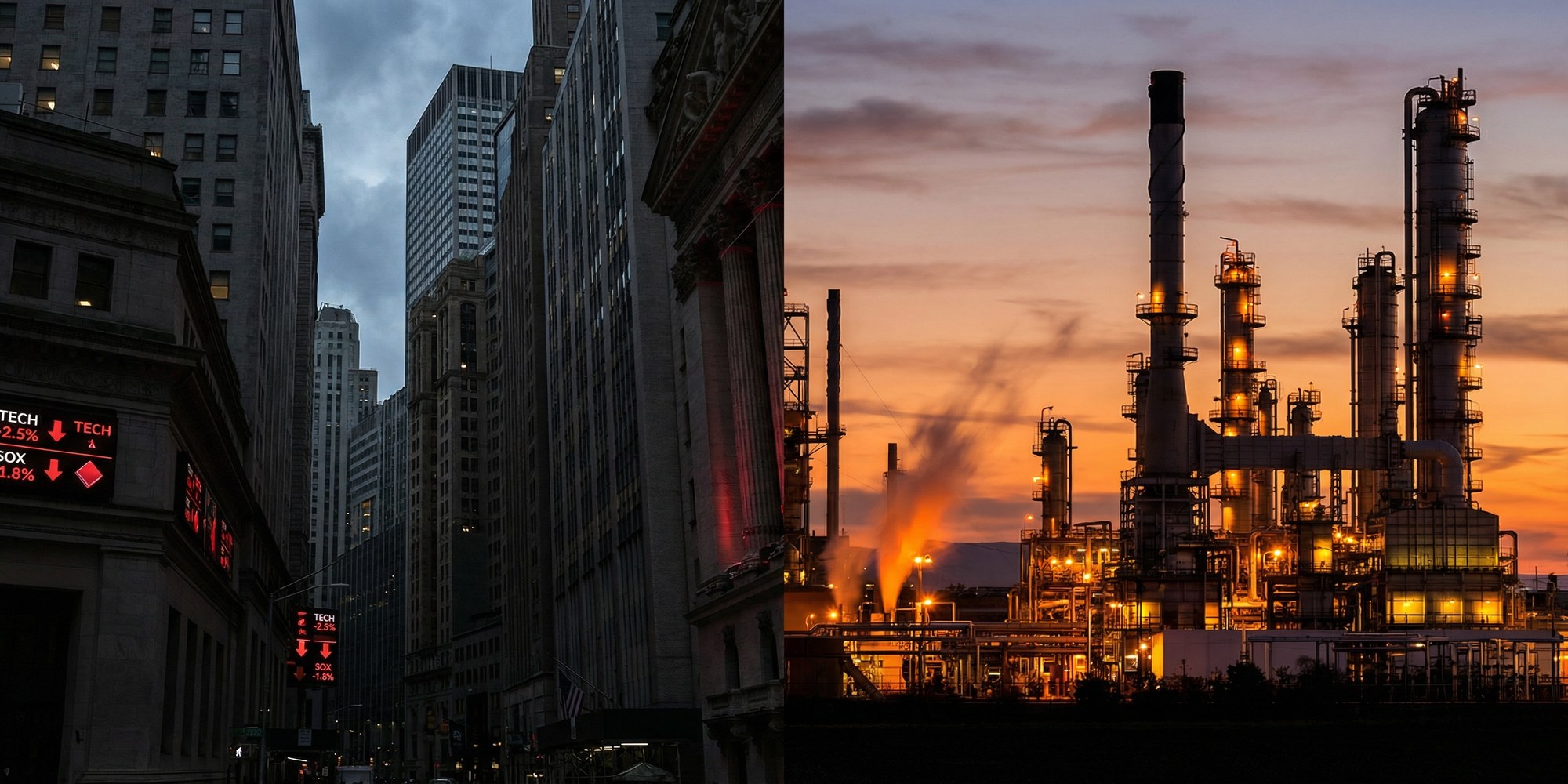
The Nasdaq Composite closed out the week of March 24–27 with a 3.23% loss — its worst weekly performance since April 2025's tariff shock — as the Iran war rewrote the winners and losers list in US equity markets. While technology megacaps gave back months of gains, the energy sector staged one of its most dramatic weekly surges in years, propelling WTI crude to $99.64 per barrel by Friday's close. The divergence was not coincidental. War-driven supply disruption is simultaneously inflating energy revenues and compressing tech valuations through higher operating costs, elevated discount rates, and heightened geopolitical risk premiums.
Tech's Unraveling: Verdicts, Sell-the-News, and AI Disruption
Meta Platforms led megacap losses with a decline exceeding 11% for the week. Two separate court defeats underscored the company's deepening legal exposure: juries in New Mexico and California handed down verdicts in child safety and social media addiction cases, rattling institutional confidence in Meta's litigation trajectory heading into an already uncertain macro environment. Alphabet shed approximately 9% and Microsoft gave up 7%, reflecting broad rotation out of high-multiple technology names as war-era energy prices push up operating costs for power-intensive data centers.
Micron Technology bore the week's steepest large-cap fall at more than 15%, in a textbook "sell the news" episode. The memory-chip maker had just reported blowout fiscal second-quarter results — $23.86 billion in revenue, with earnings reflecting the AI-driven upgrade cycle in full effect. But shares had already surged roughly 300% from their 2024 lows heading into the print, leaving limited room for upside surprises. Profit-taking was swift and steep. Nvidia and Amazon each fell approximately 3%; Tesla declined roughly 2% and was the relative outperformer among megacaps. Apple, aided by its lower energy-cost exposure and modest AI footprint, ended the week with a slight gain — a rare distinction in an otherwise punishing tech tape.
Friday's session added a new dimension: cybersecurity stocks collapsed after Fortune and Anthropic confirmed the existence of "Mythos," Anthropic's next-generation AI model, described as a step-change in autonomous capabilities. The iShares Cybersecurity ETF (IHAK) lost 4.5% in a single session. CrowdStrike, Palo Alto Networks, and Zscaler each fell roughly 6%; Okta shed more than 7%; Tenable declined 9%. The market's interpretation: an AI system capable of autonomous threat detection could materially compress the addressable market for commercial cybersecurity software.
Energy's Surge and Hormuz's New Reality
West Texas Intermediate crude settled Friday at $99.64 per barrel — a gain of 5.46% on the day and the highest closing price since July 2022. WTI briefly crossed the psychologically significant $100 threshold intraday, reaching $100.04 before retreating. Brent crude settled at $112.57, up 4.22% on the session. For context, those single-session moves would typically constitute a multi-week price event in a normal supply environment.
Rystad Energy estimated that approximately 17.8 million barrels per day of oil and liquids transits have been disrupted since the conflict began, with cumulative losses exceeding 500 million barrels. Rystad analyst Paola Rodriguez-Masiu summarized the structural shift: "The global system has moved from buffered to fragile." That assessment is consistent with the price action — each incremental geopolitical development in the Strait now carries outsized market impact precisely because there is no meaningful inventory cushion remaining.
The geopolitical situation remained fluid. President Trump extended a pause on strikes against Iranian energy infrastructure through April 6, framing the gesture as a response to Iran's allowance of ten tankers to transit the strait. Speaking at the Future Investment Initiative in Miami, Trump referred to the waterway as "the Strait of Trump" — a rhetorical rebranding that drew immediate market commentary. Meanwhile, COSCO, the world's fourth-largest shipping line, attempted a strait passage on Friday and was turned back by Iranian naval vessels — the first major carrier to test the blockade since the conflict began. Iranian state-aligned media separately reported that Tehran is drafting legislation to impose tolls on transiting vessels, which would establish a framework for partial reopening on Iran's terms. For geopolitical analysis of how Iran's access regime is evolving, see Foreign Diplomacy's analysis of Tehran's Hormuz Toll Booth strategy.
Fed Leadership Uncertainty Compounds the Risk Premium
Federal Reserve Chair Jerome Powell's term expires in May 2026, and the succession question is far from settled. Trump's nominee, Kevin Warsh, faces a concrete confirmation obstacle: Senator Thom Tillis of North Carolina is withholding his vote pending the outcome of a Justice Department criminal probe related to Powell. Without Tillis, Warsh lacks a clear Senate path.
Senator Elizabeth Warren sent an eight-page letter to Warsh on March 26, accusing him of representing a "rubber stamp for Trump's Wall Street First Agenda" and noting that he had "learned nothing" from his role during the 2008 financial crisis. The letter elevated the political stakes of the nomination and signaled a contentious confirmation process if and when it proceeds.
"Uncertainty on war in Iran calls for the Fed to keep rates steady."
— Richard Fisher, former President, Federal Reserve Bank of Dallas
Powell has indicated he will remain as chair pro tempore if the succession remains unresolved by May. Fisher's call for rate stability reflects the uncomfortable arithmetic facing policymakers: $99 oil is inflationary, yet hiking rates into an economy already absorbing a war shock carries its own risks. CME FedWatch data shows rate-hike odds that spiked earlier this month holding firm — a reflection of both inflationary pressure and the institutional hesitation that accompanies Fed leadership transitions. For European parallels, Global Market Updates has covered how the UK and European central banks are navigating the same tensions as the FTSE 100 approaches 10,000 and UK gilt yields strain toward 5%.
What to Watch: April 6, Tesla, and the SpaceX Filing
The week of March 30 carries several high-stakes catalysts. Tesla's first-quarter delivery report is expected early in the week — the first significant datapoint of Q1 earnings season and a bellwether for how the war economy is affecting big-ticket consumer spending. A SpaceX/xAI IPO filing is also anticipated imminently; following the February 3 merger of the two Elon Musk entities at a combined valuation approaching $1.25 trillion, any listing would rank among the largest in market history.
The April 6 deadline on the Trump administration's pause on Iranian energy infrastructure strikes looms as the single highest-stakes macro event on the near-term calendar. A decision to resume strikes would almost certainly push WTI above $100 on a sustained basis, accelerating sector rotation out of tech and into energy. A further extension — or a preliminary agreement on Iran's proposed transit-toll framework — would likely trigger profit-taking in energy and a relief bid in Nasdaq futures. The State Department's posture at the G7 foreign ministers meeting in France, covered by US Foreign Policy's report on Rubio's Hormuz proposal, may foreshadow the administration's April 6 decision calculus.
Fed dynamics will remain in the background but cannot be discounted. With Powell's term approaching expiration and Warsh's confirmation stalled, investors face the unusual condition of monetary policy leadership uncertainty compounding geopolitical uncertainty — a combination that historically widens equity risk premiums across all sectors, but lands hardest on the growth multiples that tech valuations depend on.