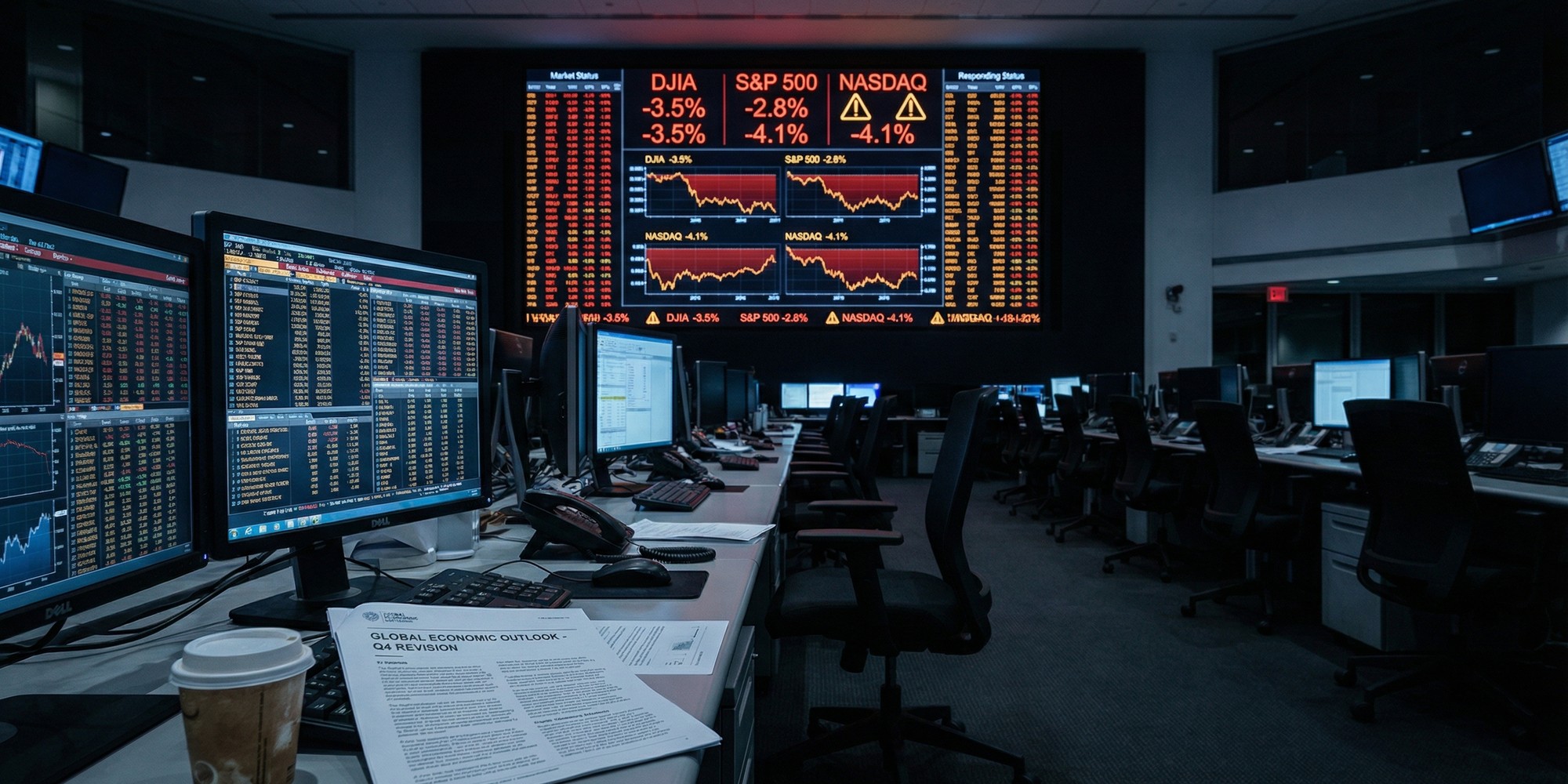
The Dow Jones Industrial Average and the Nasdaq Composite entered official correction territory on Friday, March 27 — defined as a decline of 10% or more from a recent peak — and as Q2 opened Monday the S&P 500 stood just 1.8% from joining them. US equity futures opened the new quarter modestly higher, S&P futures up 0.28% and Dow futures up roughly 68 points, a tentative stabilization that analysts attributed not to any resolution of the underlying conflict but to contradictory diplomatic signals from Washington. Brent crude touched $115.27 per barrel at Monday's open, extending what is on course to be the steepest single-month rally on record. Gold opened at $4,532.10, a fresh nominal all-time high.
The Correction Is No Longer Hypothetical
The S&P 500 closed Friday at 6,368.85, down 1.67% on the session. The Dow fell 793 points, or 1.73%, to 45,166.64 — the decline that formally pushed it below the 10% correction threshold from its recent high. The Nasdaq Composite fell 2.15% to 20,948.36, deepening its own correction. The S&P 500 stands approximately 8.2% below its February 19 peak of roughly 6,937, meaning less than two additional percentage points of downside would confirm a correction across all three major benchmarks simultaneously.
The five-week losing streak — the longest for any of the major US indices since the onset of the COVID-19 pandemic in early 2020 — has erased roughly 560 points from the S&P 500 since mid-February. Monday morning futures showed modest relief, but strategists were uniformly cautious about reading the tentative bounce as a reversal.
"If you look at the degree of the downside and how correlated all those stocks have been, it's likely that we are throwing the baby out with the bathwater. It's a great opportunity to be sharpening the pencils to say, what are the areas that will be more immune to something like AI disruption and are on sale."
— Cameron Dawson, Chief Investment Officer, NewEdge Wealth (CNBC, March 27, 2026)
Across Asia Monday, the selling was sharper. South Korea's Kospi plunged as much as 5% intraday before paring losses to close down 2.97% at 5,277.3. Japan's Nikkei 225 fell 2.79% to 51,885.85 as yen strength — USD/JPY near 158.7 — compressed yen-denominated earnings estimates. European markets, by contrast, stabilized: the FTSE 100 gained 0.55% on its energy-heavy index weighting, while the DAX slipped 0.22%.
Trump's "Take the Oil" and What Kharg Island Means for Markets
The clearest market catalyst heading into Q2 arrived Sunday in an interview with the Financial Times, in which President Trump said his "preference would be to take the oil" in Iran — specifically, to seize Kharg Island, the Persian Gulf hub through which roughly 90% of Iran's crude exports flow.
"Maybe we take Kharg Island, maybe we don't. We have a lot of options. It would also mean we had to be there for a while."
— President Donald Trump, Financial Times interview, March 29, 2026
Brent crude surged on the remark, extending a March rally that has taken the benchmark from roughly $75 per barrel in late February to the $115 range as of Monday's session open. March's cumulative gain of approximately 55% is tracking toward the steepest single-month rise on record for Brent, according to CNBC reporting. WTI crude crossed the $100 per barrel threshold at the open, trading at $100.89.
David Roche, founder of Quantum Strategy, told CNBC that a seizure or strike on Kharg Island could remove 4 to 5 million barrels per day from global supply in a full-escalation scenario — approximately 4% of the world's daily consumption. Ed Yardeni of Yardeni Research noted that global equities were beginning to reflect a "higher-for-longer" oil and interest rate environment: "The continued blockade of the Strait of Hormuz could deepen the market pullback and raise recession risks." The Pentagon reportedly had an additional 3,500 troops arriving in the region on Friday, March 27, with units from the 82nd Airborne Division ordered to support the ongoing war effort.
For the Q1 2026 quarter-end context — including how global equity and commodity markets performed across the full quarter — see the comprehensive wrap at Global Market Updates.
Houthis, Kuwait, and the Fourth G7 Emergency
The Kharg Island threat was not Monday's only escalation signal. Yemen's Houthi movement announced Saturday that it had launched a barrage of ballistic missiles at Israeli military targets — the first direct Houthi engagement in the US-Israel versus Iran conflict, which began with strikes on Iran on February 28. The Houthi entry significantly widens the geographic footprint of the war, adding pressure to Red Sea shipping lanes and the Bab al-Mandeb chokepoint already disrupted by the broader conflict.
Reports Monday also cited alleged Iranian attacks on water and power desalination facilities in Kuwait, signaling that Tehran may be extending its retaliatory reach into Gulf Cooperation Council states beyond the direct theater of operations. If confirmed, the incidents would represent a significant escalation of infrastructure warfare. A full geopolitical assessment of Iran's proxy network — including the Houthi re-entry into active hostilities — is available at Foreign Diplomacy.
G7 finance ministers, energy ministers, and central bank governors convened virtually Monday for the fourth emergency G7 gathering since the war began five weeks ago. The frequency of those sessions underscores the institutional strain now extending across global energy and financial systems. Seth Krummrich, former US chief of staff for Special Operations at CENTCOM, offered a blunt assessment on CNBC: "We're probably closer to the beginning or to the middle of this story than we are to the end."
Why the Market Isn't Collapsing Further — Yet
Despite the hawkish Kharg Island comments, Trump also signaled the opposite in the same FT interview: indirect talks via Pakistani intermediaries were "progressing well," he said, adding that Iran had "agreed to most of the 15 points" in the US peace proposal — "They gave us most of the points... They're agreeing with us on the plan." Iran also allowed approximately 20 oil tankers through the Strait of Hormuz over the weekend, a gesture Trump described as "a sign of respect."
These competing signals — maximum-pressure rhetoric paired with optimistic diplomatic framing — are creating enough market confusion to limit the Q2 sell-off without reversing it. Monday's modestly positive futures represent investors pricing diplomatic optionality rather than a fundamental change in the conflict's trajectory. The oil market, unlike equities, is assigning a low probability to a rapid de-escalation: Brent's sustained position above $115 reflects the market's base case that this conflict will remain a supply disruption for weeks to months, not days. Competing visions for post-conflict governance of Iran's oil infrastructure are a separate source of friction among US allies, detailed by US Foreign Policy.
Looking Ahead: Holiday Week, Data Barrage, and April 6
The week of March 30–April 3 is holiday-shortened: US equity markets are closed Good Friday, April 3. The Bureau of Labor Statistics' March nonfarm payrolls report is scheduled for release that morning regardless, meaning the market reaction will be deferred to the open of Monday, April 6. That Monday also coincides with the expiration of Trump's self-imposed Iran strike pause deadline — creating an unusual concentration of potential catalysts on a single trading session.
This week's economic calendar includes JOLTS job openings on Tuesday, ADP private payrolls data Wednesday morning alongside retail sales and ISM manufacturing, and PCE price index data later in the week. Nike reports Q3 earnings this week, serving as an early-cycle read on consumer discretionary spending in an environment of elevated gasoline and goods prices. Q1 earnings season proper begins the following week, with JPMorgan Chase, Goldman Sachs, and Wells Fargo all expected to report the week of April 6 — establishing the financial sector's initial posture on the oil-shock environment. The Bank of Japan's April 28 meeting is also on the radar as a global risk event: BOJ policymakers discussed further rate hikes at their March session, with one member warning that the central bank risked falling "behind the curve" as oil-driven inflation accelerates.